What Makes a Healthy Intimate Relationship? Lessons We Learned the Hard Way
We thought love was about finding the right person. We were wrong.
We'd been together for two years when I realized something was fundamentally broken.
It wasn't the big fights. The screaming. The accusations. Those were obvious problems. It was the small moments. The way I'd text her three times if she didn't reply in ten minutes. The way she'd panic if I wanted to spend Saturday with my friends instead of her. The way we both needed constant reassurance that the other person was still there, still cared, still wasn't leaving.
We were exhausted. And we were exhausted together.
The Moment I Realized I Was Acting Like a Child
There's a pattern I used to think was "passion."
I'd get anxious if she didn't respond immediately. I'd reread her texts looking for tone shifts. I'd pick fights over nothing because it was the only way I could feel her attention. In psychology, this is called emotional regression. But I didn't know that word at the time. I just knew I was miserable, and I was making her miserable too.
She was doing the same thing from the other side. Needing me to be her emotional anchor. Her validator. Her source of constant reassurance that she was lovable, worthy, enough. We weren't two adults in a relationship. We were two children, standing in an adult body, demanding that the other person become our parent.
And it was killing us.
Why We All Become Children in Love
Here's what nobody tells you about love: it makes you more childlike. Not in a cute way. In a potentially dangerous way.
Love breaks down psychological boundaries. When you really trust someone, your defenses drop. And without those defenses, parts of you that you don't usually show start leaking out. Parts that formed when you were five years old. Parts that learned how to get attention from your mother. Parts that never learned how to self-soothe, how to calm yourself down, how to be okay with being alone.
In psychology, this is called regression. And it's completely normal. Everyone does it to some degree.
The problem is when one person stays regressed. When they never snap back to being an adult. When they start expecting their partner to function as their opposite-sex parent: always available, always attuned, always ready to fix their feelings.
That dynamic doesn't work. Because eventually, the other person gets tired. They can't be the parent anymore. And then frustration, anger, resentment—all the emotions that break relationships apart—start showing up.
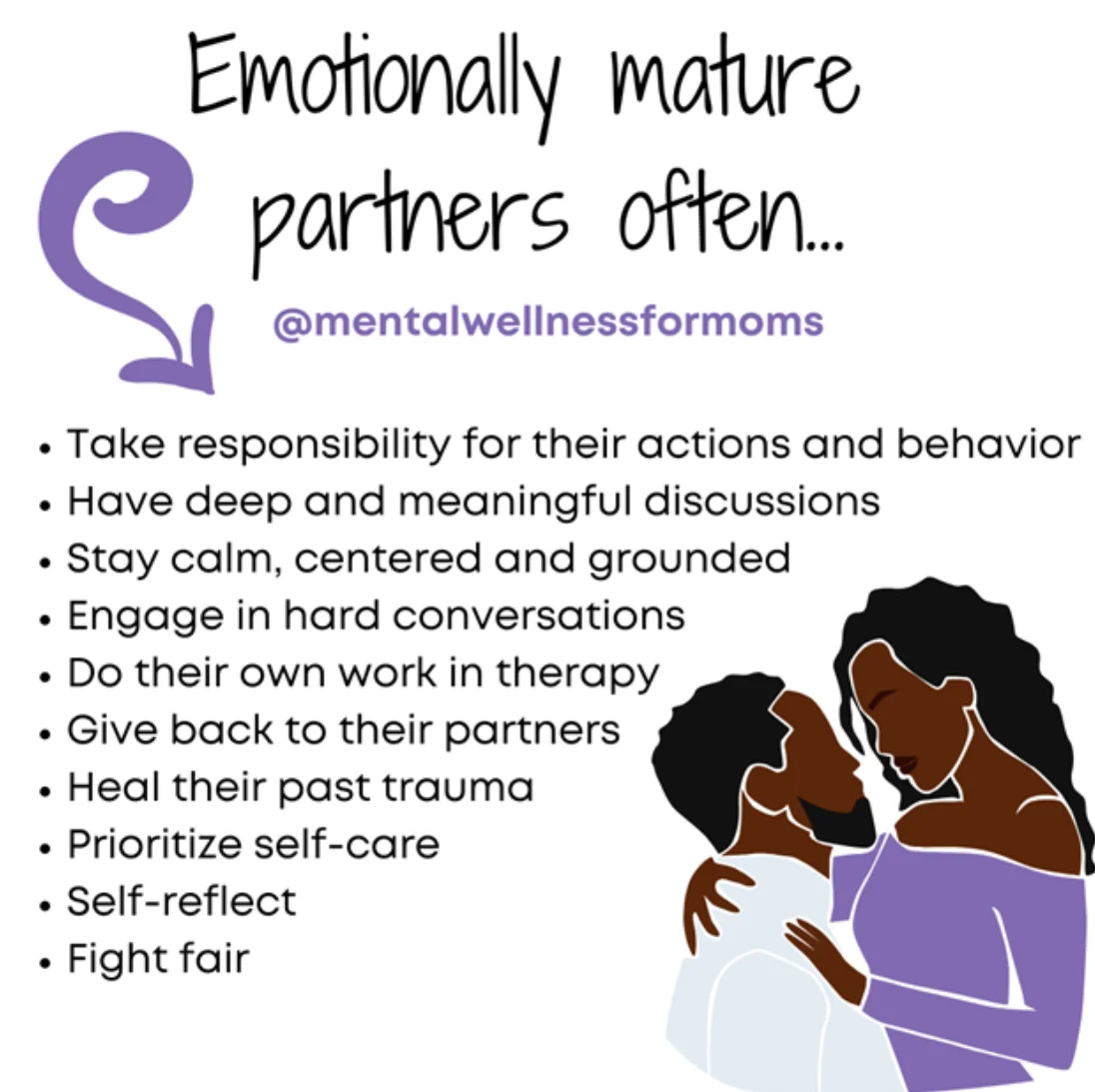
What an Emotionally Mature Relationship Actually Looks Like
After that relationship ended, I spent a lot of time thinking about what went wrong. I read about emotional systems. I learned about what makes a healthy intimate relationship different from the one we'd had. And I started seeing the patterns in retrospect.
An emotionally mature relationship is built on something different from what I'd been chasing. It isn't about constant togetherness. It isn't about perfect understanding. It isn't about someone being your everything.
It's about two people who have their own emotional systems mostly intact. Who can calm themselves down. Who can sit with discomfort without making it the other person's problem. Who can ask for what they need without demanding it as if their survival depends on it.
That sounds simple. But it's incredibly rare. Because most of us didn't learn how to do that as children. We learned to get comfort from outside. And then we brought that pattern into adulthood, and into love.
The Difference Between Emotional Need and Emotional Dependency
There's a line between wanting someone and needing them to function. And most of us don't know where that line is until we cross it.
I used to think I was just "affectionate." I thought wanting to spend all my time with her, wanting constant contact, wanting to be her top priority every moment of every day—that was what love looked like. It wasn't. It was emotional dependency, dressed up as devotion.
Here's how you know the difference:
Emotional need is: I feel better when you're around. I miss you when you're gone. I like sharing my life with you.
Emotional dependency is: I can't function when you're not available. Your absence feels like abandonment. My mood is entirely determined by your attention to me.
One is healthy connection. The other is using another person to fill a hole you haven't learned to fill yourself.
And when both people are doing that, you don't have a relationship. You have a mutual dependency pact. Which is exhausting for both of you.
What It Actually Means to Have a Complete Emotional System
I used to think people with complete emotional systems were just born that way. Like some people are naturally calm and others are naturally anxious. But that's not true. Emotional systems are built. And most of us have incomplete ones because no one ever taught us how to build them.
A complete emotional system means a few things:
You can affirm your own worth. Not perfectly. Not all the time. But enough that one person's bad mood doesn't collapse your sense of self.
You can sit with your own emotions. Not immediately fix them. Not immediately text someone to make them go away. Just feel them, let them move through, and know that you'll be okay on the other side.
You can empathize without absorbing. You can care about someone else's pain without making it your own emergency.
You can be alone without being lonely. Not every weekend. Not every evening. But enough to know that your own company is survivable, even sometimes enjoyable.
You can ask for care without demanding it. You can express what you need, but you don't punish someone for not giving it exactly how or when you wanted it.
When both people have this mostly in place, the relationship becomes a place of growth instead of a place of need.
The Obsession That Kills Most Relationships
I used to watch her every move. Her tone. Her facial expressions. Whether she seemed slightly less enthusiastic than yesterday. I'd ask, "Are you okay?" ten times a day, but I wasn't really asking if she was okay. I was asking if I was still safe. If she was still satisfied. If she was still going to stay.
That's what kills relationships. Not the big betrayals. The constant monitoring. The constant evaluation. The constant search for reassurance that you are still enough.
When you do that, you create a prison for both of you. She can't be authentic because she knows you're scanning for danger. And you can't relax because you're always on alert. You both lose.
The healthier alternative is terrifying at first: trusting that someone can have a bad day, a distracted mood, a need for space, and it doesn't mean anything about you. That's emotional maturity. And it's the hardest thing to learn if you never learned it as a child.
Why We Try to Control the People We Love
This was the hardest lesson for me. I thought I loved her. But I was actually trying to shape her into someone who could perfectly manage my emotions. Someone who would never trigger my anxiety. Someone who would always respond the way I needed, think the way I wanted, prioritize what I wanted prioritized.
That's not love. That's emotional control, wearing the mask of love.
And when she inevitably couldn't be that person—because no one can be that person—disappointment, blame, and resentment showed up. Not because she was failing. Because my expectations were impossible.
This is why so many relationships collapse. One person is using love as a demand. "If you loved me, you'd be this way." And the other person is slowly being erased under the pressure of becoming someone else's ideal.
True love allows the other person to exist as they are. Imperfect. Real. Human. Not your fantasy. Not your parent. Just themselves.
What a Psychologically Safe Relationship Feels Like
The relationship I'm in now is different. Not because it's perfect. Because it feels safe. Not safe as in "nothing bad ever happens." Safe as in: I can say what I actually feel, and I won't be punished for it.
I can say, "I'm feeling insecure about something, and I know it might not be rational, but I need to talk about it." And she can hear it without taking it as an attack or a demand. She can say, "I need some space tonight, it's not about you," and I can hear it without spiraling into abandonment panic.
We both still have our moments. We're both still learning. But the foundation is different. We're not trying to parent each other. We're trying to be two adults, sharing a life, and supporting each other without carrying each other.
That feels lighter. That feels sustainable. That feels like something that could actually last.
The Most Surprising Change in Our Relationship
One thing I didn't expect was how intimacy changed when the emotional foundation shifted.
In my previous relationship, physical intimacy was tangled up with anxiety. It was about reassurance. About proving we were still connected. About using closeness to fill the gaps that communication couldn't bridge. It was performative, even when we didn't realize it.
In this relationship, it's different. Because the emotional safety is there, intimacy became something we could explore without pressure. Without needing it to mean something bigger than what it is. Without using it to fix something broken.
We started exploring new ways to be close together. Including things I'd never considered before, like a couples' relaxation tool designed for shared experiences. Not because something was missing. But because creating intentional space for physical connection, when the emotional foundation is solid, feels completely different. It feels playful. It feels generous. It feels like both people are giving something instead of one person trying to get something.
That shift—from intimacy as anxiety management to intimacy as exploration—is what emotional maturity makes possible.
What I Now Know About Healthy Love
Healthy love isn't about finding someone who makes you feel whole. It's about being someone who is already mostly whole, and finding another person who is also mostly whole, and choosing to walk together.
It requires emotional maturity. Not perfection. Not enlightenment. Just enough self-awareness to know when you're regressing. Enough self-regulation to calm yourself down sometimes. Enough self-worth to know that your partner's mood is not your report card.
It requires psychological stability. Not constant happiness. Just the ability to handle life's normal ups and downs without making your relationship the dumping ground for every discomfort you feel.
It requires mutual respect. Not agreement on everything. Just the basic acknowledgment that the other person is a separate human being with their own needs, moods, and boundaries.
It requires emotional safety. Not the absence of conflict. Just the confidence that you can disagree, express hard things, and still be loved.
And it requires authenticity. Not brutal honesty. Just the willingness to show up as yourself, rather than the version of you that you think will keep the other person from leaving.
That is what truly defines a healthy intimate relationship. And it's not something you find. It's something you build, together, one day at a time.