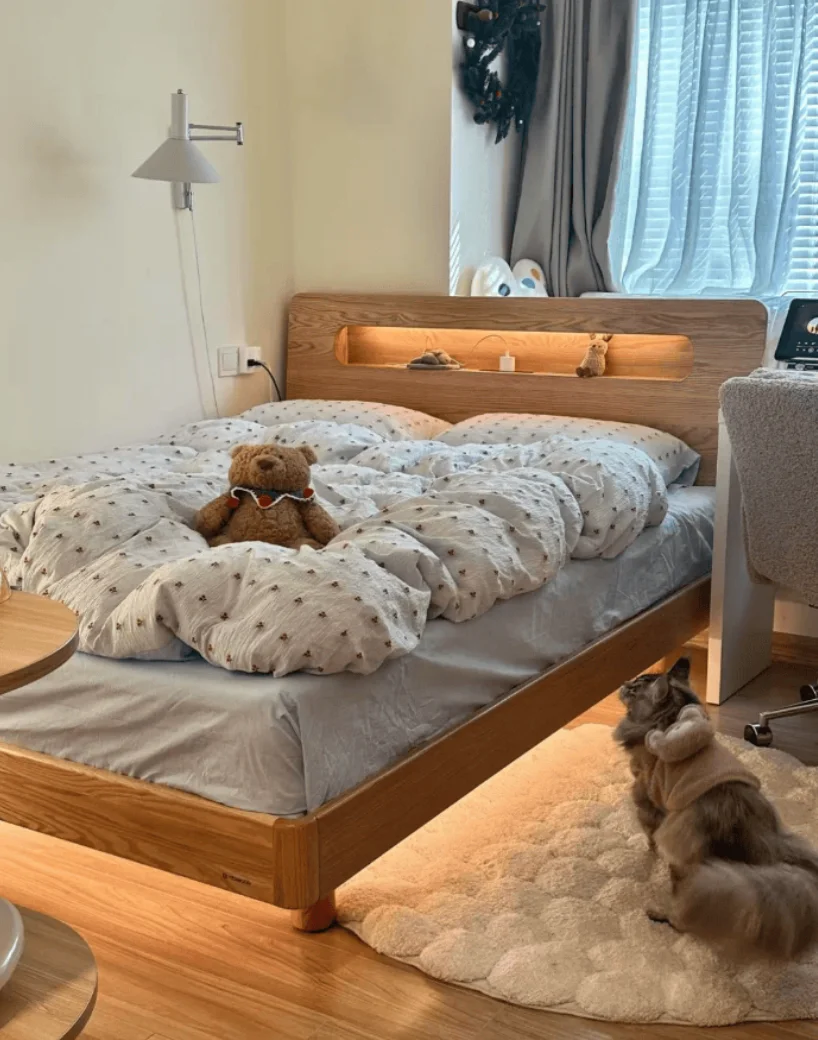
Bedtime Preparation
1. The Quick Sleep Method
I know many of you say you really can't fall asleep at night. You feel very tired, but when it's time to sleep, all sorts of thoughts keep running through your mind, and you toss and turn, unable to fall asleep.
From a biological perspective, this is because your neurotransmitters are imbalanced.
Neurogens are substances that connect neurons in the brain. When they are imbalanced, our brains naturally feel stressed, experience mood swings, and have difficulty falling asleep.
Therefore, although we can't intervene mentally, we can treat insomnia through microcurrent stimulation.
Does that sound impressive? Actually, all you need is a sleep aid device; the microcurrent stimulation can help you fall asleep quickly. This is the number one selling sleep aid on JD.com, and I've personally tried it. Results may vary from person to person, but it was quite effective for me. It's small and easy to hold in your hand. When I was staying up very late every day and wanted to adjust my sleep schedule, holding this little sleep aid helped me fall asleep quickly and adjust my sleep schedule! I have to say, this is really practical!
2. Don't use electronic devices, such as phones or tablets, for an hour before bed.
Sigh, I know you still won't do this after hearing it.
Why? Because I can't do it either (crying).
Have you noticed that the more you scroll through your phone before bed, the more awake you become? It's often because the content triggers our "emotions."
For example, scrolling through WeChat Moments and seeing your best friend posting tempting food photos late at night—who can resist that?!
So, scrolling through your phone before bed isn't necessarily bad, but we should try to avoid places where strong emotions might arise, such as WeChat Moments or Weibo (you might find some juicy gossip and get instantly excited, haha).
You can read some calming articles or listen to light music before bed. I especially like piano music; I fall asleep while listening to it~
3. Stretch before bed.
I highly recommend this!! Especially for those of you who want a beautiful figure. Don't underestimate just 10 minutes of stretching a day; it can make your body lines more slender.
4. Never eat before bed.
If you're really hungry, eat some nuts, drink some milk or yogurt (but not too cold, or you'll get diarrhea), or eat an apple—these are all good choices.
By the way, if you're very, very hungry at night, it means you didn't eat dinner properly! If you want to lose weight, never try to lose weight through dieting—I learned this the hard way! Frequently going hungry will disrupt your hormone regulation, making you crave food like a starving tiger, which will actually make you gain more weight.
5. Try to avoid coffee. If you have severe insomnia, avoid coffee after lunch. Also, limit alcohol consumption, as alcohol disrupts sleep.
Moderate exercise during the day can help you sleep better at night. In fact, 50% of people with insomnia don't like to exercise. So even when you're busy with work or study, you can do some stretching exercises in between, making good use of spare moments. Note that you shouldn't do strenuous exercise before bed, otherwise your heart will be pounding when you lie down…
6. Follow your body's biological clock.
I've noticed that when my sleep schedule was chaotic, I'd get sleepy in class and have terrible energy all day, but then I'd be incredibly energetic at night when it was time to sleep.
My current schedule is almost like an elderly person's: I go to bed at 10:30 pm and wake up naturally at 6:30 am, feeling energetic all day, and then I take a nap at noon—it's wonderful!
Going to bed and waking up on time—a regular schedule helps us get a good night's sleep.
7. Try not to sleep in on weekends either.
I know you'll say, "I've been busy all week; if I keep the same schedule every day, I won't be able to sleep in on weekends, which is my source of happiness for the whole week!"
Often, because we're too tired during the week, we sleep until 11 or 12 pm on weekends, disrupting our established sleep patterns, and then trying to readjust them is very painful.
Since sleeping in late is actually for relaxation and enjoyment, you can wake up at a normal time (for example, if you usually wake up at 7:00, then wake up at 7:00 on the weekend). After waking up, take out your favorite show and snacks. Enjoy your snacks while watching your show. This way, you can enjoy the weekend without disrupting your biological clock – why not?
8. Avoid naps during the day or at night (especially four or five hours before bedtime). If you must nap, make sure it doesn't exceed 20 minutes.
Environment
1. Open the bedroom curtains.
This way, the morning sunlight will naturally wake us up, because in primitive societies we rested at sunset and worked at sunrise.
Therefore, sunlight is the best way to wake us up. We wake up naturally this way without feeling the pain of getting out of bed.
2. Ensure the bedroom has a suitable temperature.
The optimal room temperature for sleep is around 20 degrees Celsius.
The key is to maintain a comfortable temperature. It's really difficult to fall asleep when it's too cold or too hot; you'll toss and turn and feel very uncomfortable.
3. Keep your bedroom as dark as possible.
Some people might need a little light to sleep, which could be a habit.
However, my advice is to keep it completely dark when sleeping.
Exposing yourself to light inhibits melatonin production, thus reducing sleep quality.
4. Reduce bedroom noise.
So, if you have a roommate who likes to play games late at night and makes noise, you can politely remind them. You can also bring earplugs or use noise-canceling products.
5. The more comfortable your bed and pillow, the better you'll sleep.
A 2012 US study found that a suitable mattress, pillow, and even clean sheets can help improve sleep quality.
The importance of a good mattress and pillow is self-evident. I have a habit I've maintained for over 5 years that I want to share with you: The pillow isn't for your head, but for your neck. I use a buckwheat pillow, so I manually elevate the neck section. This is very beneficial for your cervical spine!
To make it easier for you to understand, I'll summarize it in sections:
Mindset Section Often, the problem lies in our own mindset. The more we think about sleeping, the less we can fall asleep.
In fact, this is a frustrating paradox: sleep is one of the few things that becomes more difficult the harder you try.
Sleep experts call this "sleep effort," meaning that when we consciously put more effort into sleeping, it has the opposite effect.
So, sometimes the more you have insomnia, the harder it is to fall asleep; conversely, when you don't worry about it, you sleep better.
The first misconception we should dispel is: I have insomnia, I'm so anxious! I need to solve my insomnia problem immediately!
But in reality, this isn't the case. One or two bouts of insomnia won't significantly impact our lives. It's our anxiety about insomnia that makes us even more anxious, creating a vicious cycle.
If you feel that not sleeping well at night isn't a big deal, just let it be and don't make futile efforts; you're more likely to fall asleep this way.
Therefore, stop "trying" to sleep. Sleep is a skill. Follow my process, and you'll definitely achieve better sleep quality and stop worrying about sleep, leading to a more vibrant life.
The Principles Think about it: sometimes you don't sleep for long, but you wake up feeling refreshed? Or you stay in bed for two or three hours, but still feel groggy when you get up?
Actually, this is based on the neuroscientific principles of sleep. It's not complicated, but understanding it will greatly change your life!
Here's a brief explanation of the R90 sleep method: Mammal sleep can be divided into REM sleep (light sleep) and non-REM sleep (deep sleep). For most people, a complete sleep cycle is 90 minutes.
The key to good sleep is when you wake up!
If you can wake up during light sleep, you'll feel refreshed—it feels amazing!
Since our sleep cycle is 90 minutes, we can schedule our sleep and wake-up times in multiples of 1.5 hours.
The number of sleep cycles needed varies from person to person. Some people need 4 cycles (6 hours), while others need 5 cycles (7.5 hours). Everyone is different. You can judge how many sleep cycles you need based on how you feel after waking up (refreshed or groggy).
Note that the sleep time here refers to the time you actually sleep! It doesn't include the time spent lying in bed counting stars!
Here's an example flying towards you!
For example, when you first start adjusting, you can lie down at 11:30 PM, prepare to fall asleep for about 30 minutes, and set an alarm for 7:00 AM. Or, like me, you can go to sleep even earlier, at 10:30 PM and wake up at 6:00 AM. You can also try sleeping only four sleep cycles (6 hours) and see if you're still sleepy after waking up. If so, you can take another half-hour nap. If possible, it's best to take a nap at noon, or even just lie down for a while if you can't fall asleep, because this short nap can keep you energized for the whole afternoon—it's so worthwhile!
Therefore, it's essential to maintain a regular schedule and get enough sleep; this is the foundation for high-quality learning and work!
Supplementary Section
1. The Importance and Precautions of Napping.
I don't know if you have the habit of napping, but for me, a nap is like a "power bank," the best time to recharge my energy.
Because after working all morning, our bodies are inevitably very tired. Working or studying at this time won't be very efficient, so a half-hour nap at noon is ideal.
Even if you don't have the habit of napping, you can use that half hour for meditation or simply closing your eyes to rest. This will help you quickly restore your energy, making you much more efficient when you get back to work.
Also, if you didn't sleep well the night before, don't try to catch up on sleep during the day! That will only make you more energetic at night.
Even when you're sleepy, don't go to sleep. This will make you sleepy earlier at night, and after a few days of adjustment, you can get your sleep schedule back to normal.
2. Take it slow, it will be faster.
Changing sleep habits isn't a one-time process; it requires gradual change. Don't expect to become an expert overnight (I believe no one wants to become an expert overnight, right?).
At the same time, this is also a "once and for all" process. Once you develop a regular habit and stick to it, you'll see how much you can gain from your sleep that you never imagined.