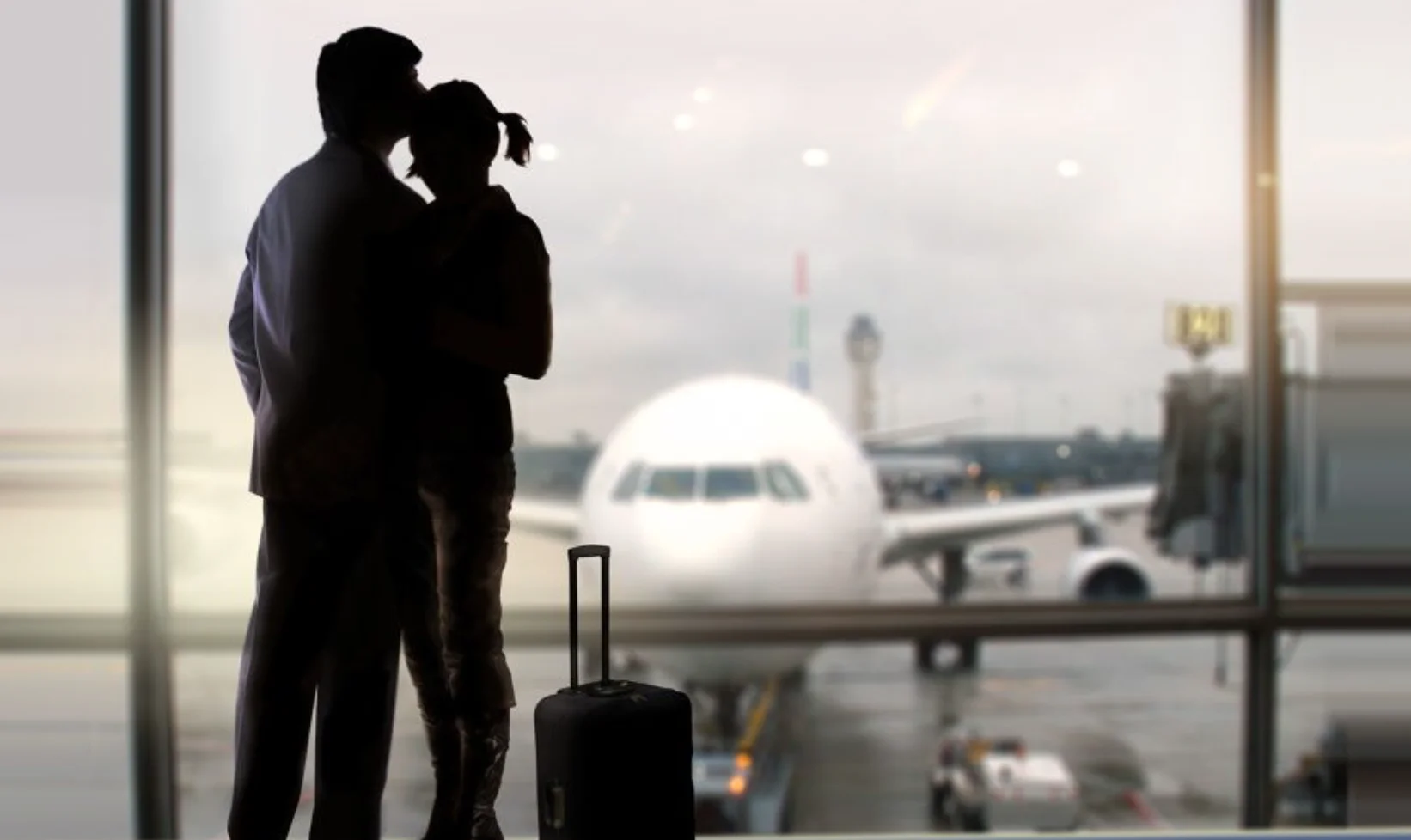
Long Distance Intimacy for Couples Who Travel: What Actually Helped Us Stay Connected
What happens when your job keeps you in different countries
I travel too much. That's the short version.
Last year I counted. Two hundred and seventeen days on the road. New York. Singapore. London. Back to Dubai for forty-eight hours, then out again. My partner has a job that keeps her here. She can't leave. I can't stay. And somewhere around month six, we realized that our relationship was becoming a management problem.
Not because we stopped loving each other. We didn't. We talked every day. Video calls. Voice messages. The whole thing. But there was a gap we couldn't name. A physical absence that video couldn't fill. Not sex. Something simpler. The weight of a hand on your shoulder. The warmth of someone next to you in the dark. The fact that another body is breathing in the same room.
I started feeling lonely in hotels. Not homesick. Lonely. Like my body was registering that the other person wasn't there, even when my brain knew we were fine.
Why Video Calls Weren't Enough
We tried everything before we tried anything physical. More calls. Scheduled dates. Watching movies together on FaceTime. It helped. It kept us connected. But it kept us connected at the level of conversation. Not the level of touch.
Here's what I noticed. After two weeks apart, I'd start feeling irritable for no reason. Not at her. At everything. Traffic. Emails. The hotel pillow. My body was tense in a way that exercise didn't fix. Sleep didn't fix it. Nothing fixed it except going home. And I couldn't go home every two weeks. Not with my schedule.
My partner felt it too. She said she was sleeping worse. That she felt like she was managing the relationship alone. That our calls were becoming updates instead of connection. Status reports. How was your day. What did you eat. Fine. You. Good. Miss you. Bye.
We were both present. And both absent.
The First Time We Talked About a Remote Device
I brought it up. She was surprised. I was surprised. It wasn't something we'd ever considered. We weren't "toy people." We didn't have a drawer of gadgets. Our intimacy was simple. Uncomplicated. Physical presence had always been enough.
But physical presence wasn't available anymore. And we had to decide: do we let the distance slowly erode the physical part of our relationship, or do we try something that might help us maintain it?
She was hesitant. I was too. There's a stigma. It feels like admitting defeat. Like saying: our bodies aren't enough, we need technology. But that's not what it is. Technology is just a bridge. The connection is still between the two people. The device is just the wire.
We ordered one. A paired device. Small. Quiet. No lights. No logos. Designed for long-distance couples. She would have one. I would have one. And they would connect.
What the First Experience Actually Felt Like
I was in a hotel in London. She was in our apartment in Dubai. Nine hours ahead. We picked a time that worked for both of us. Late evening for her, early afternoon for me. I drew the curtains. She lit a candle. We got on a video call. And then we started.
The device was warm. Not hot. Just warm. Like skin. And it moved slowly. Not a vibration. More like a pulse. Something that felt like pressure rather than buzzing. I could feel it responding. Not randomly. In a way that felt connected to what was happening on the other end.
That was the strangest part. The feeling of being touched by someone who wasn't there. Not a simulation. Not a recording. Real-time. Her rhythm, translated into sensation. My body felt it as her. Not as a machine. As her.
Afterward, we didn't hang up immediately. We talked. Laughed. The way we used to after being close. Not because the device had done something magical. But because our bodies had shared an experience, even across distance. We felt more connected. More relaxed. The feeling of being together, not just informed, was there.
What Changed After a Month
We started using it regularly. Not every time we were apart. But when we needed it. When the gap was starting to feel like a wall. When we were both present in the conversation but absent in our bodies.
The change was gradual. I stopped feeling lonely in hotels the way I used to. Not because the device replaced her. It didn't. But because it maintained the physical channel between us. The part of our relationship that video calls couldn't keep alive. The part that was dying from distance.
She said she felt closer to me on the road than she had before. That our conversations changed. Less status updates. More presence. Because we had a shared physical experience that anchored us, even when we were in different time zones.
The device didn't fix everything. It didn't make travel easier. It didn't make the distance shorter. But it made the distance feel less like a loss. More like a challenge we were managing together.
Long Distance Relationship Tips for Couples Who Travel Frequently
After a year of this, we've learned a few things that help. Not just the device. The whole system of staying connected when you're rarely in the same place.
Schedule the connection, not just the call.
We used to call whenever we had time. That meant one person was always tired, distracted, or rushing. Now we schedule one dedicated window per day. Same time. Both of us are present. It sounds small, but it changes the quality of the conversation entirely.
Share one small experience, not just updates.
Instead of "how was your day," we share one thing. A photo of a street. A voice note from a café. A screenshot of something funny. It keeps the other person inside your world, not just informed about it.
Create a ritual that bridges the distance.
For us, the device became that ritual. But it could be anything. A shared playlist. A movie watched at the same time. A letter sent once a week. The point is: create something that feels like shared space, not just shared information.
Don't try to replace being there. Maintain the channel.
The goal isn't to simulate being together. It's to keep the connection alive enough that when you are together, you don't have to rebuild it from scratch. That's the real difference between couples who survive distance and couples who grow apart.
Long Distance Relationship FAQ
Can long-distance couples stay emotionally connected?
Yes. Consistent communication, shared experiences, and intentional intimacy rituals can help couples maintain connection despite distance. The key is not just frequency but quality—being present during the time you have, rather than treating calls as background noise.
How do couples maintain intimacy while traveling?
Many couples schedule dedicated video calls, share experiences remotely, and use app-connected intimacy devices to maintain a sense of closeness. What works varies by couple, but the common thread is intentionality: making the connection deliberate rather than accidental.
Do remote intimacy devices work for long-distance relationships?
For some couples, they can help maintain a feeling of physical connection when regular in-person contact isn't possible. They're not a replacement for being together, but they can serve as a bridge between visits. Individual experiences vary widely.
What are the biggest mistakes couples make when apart?
Trying to maintain constant contact, which creates pressure and fatigue. Neglecting the physical dimension entirely, assuming conversation is enough. And letting resentment build without addressing it—small irritations compound when you can't read body language or offer immediate comfort.
What I Now Understand About Long-Distance Intimacy
Physical intimacy isn't just about sex. It's about maintaining a closeness that goes beyond conversation. When you spend most of your time apart, you lose the small physical signals that keep a relationship grounded. The hand on the shoulder. The shared space. The feeling that someone is actually there with you.
Video calls maintain the emotional connection. The conversational connection. But they don't maintain the physical one. And for some couples who travel, the physical connection is the foundation that keeps the other connections strong. When it weakens, everything weakens.
The device we use isn't a replacement. It's a bridge. A way to keep the physical channel open when geography closes it. It's not as good as being there. Nothing is. But it's better than letting the channel close completely.
Our Long-Distance Intimacy Setup
The paired device we use is part of a collection designed for couples who travel. Small, quiet, warm, and responsive. Connected through a private network. For couples who value discretion as much as connection.
All orders are processed with end-to-end encryption and delivered via private, unbranded concierge service. For couples who value discretion as much as connection.